

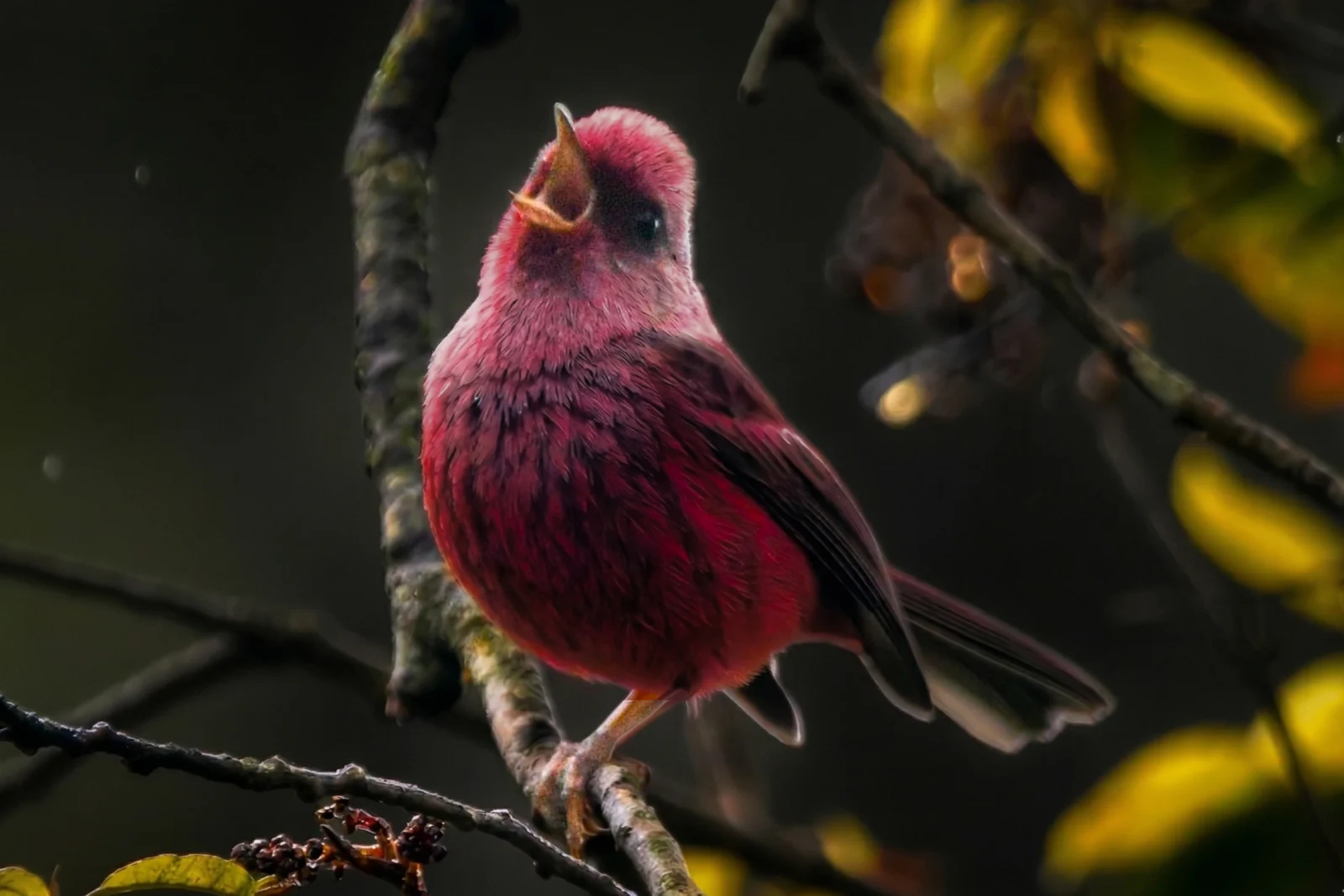
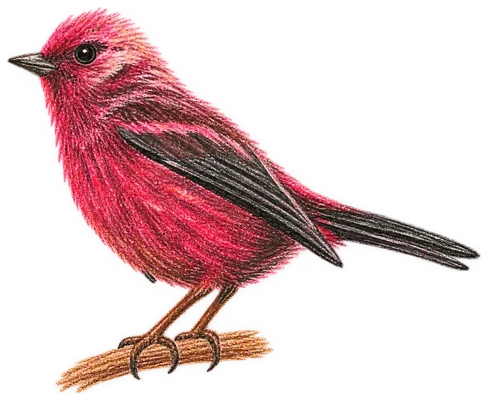
Some birds you meet on the way to something else. Others you have to go and find where they live. The Pink-headed Warbler (Cardellina versicolor) is the second kind. It lives above 2,000 metres, among pines and oaks, and outside the highlands of Guatemala and Chiapas it occurs nowhere else in the world.
Stay a while, I’ll tell you my secrets
Where it lives
we can find it only in Guatemala and Chiapas
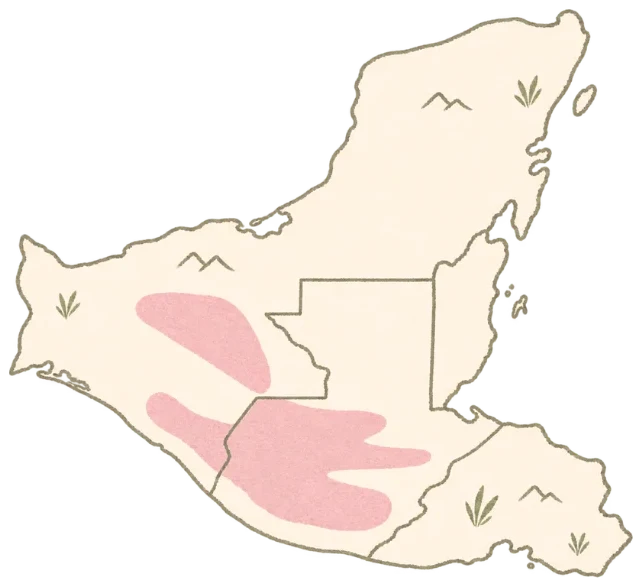
It occurs mainly above 2,000 m, in forests of conifers, alders and oaks.
Its range fits inside a small rectangle of the map: the mountains of southern Chiapas and the highlands of western and central Guatemala. Inside that rectangle you still have to look for it in the right forest, at the right elevation. Outside it, the bird simply is not there.
This is what biologists call a regional endemic: a species spread across a region drawn by its natural history rather than by the borders of countries. The Pink-headed Warbler shares that region with other birds that exist nowhere else. We wrote about them in Birds that exist only here.
What it eats
its main food is insects
Good protein to start the day
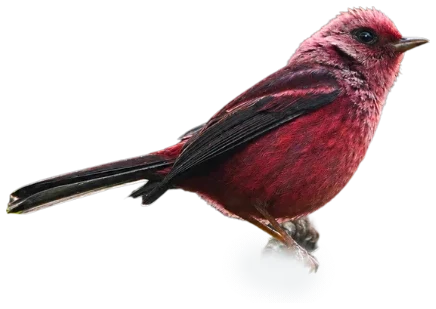
It also feeds on fruit. It forages in the vegetation growing below the trees, the understorey.
That has a practical consequence for anyone looking for it: do not look up. The Pink-headed Warbler hunts insects close to the ground, among low branches and shrubs, not in the canopy. Search the treetops and you can spend a whole morning standing underneath a bird that was at eye level.
Its relative to the north
Hey bro
Hey bro
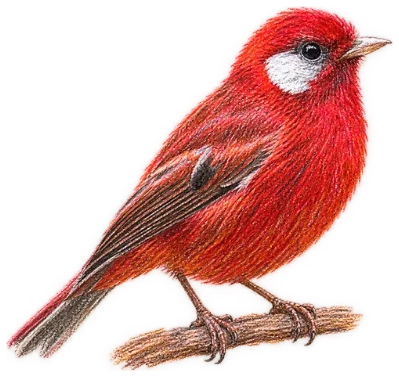
A DNA analysis identified these two species as sister groups (Lovette et al. 2010).
The Red Warbler (Cardellina rubra) lives in the highlands of Mexico and resembles ours closely enough to make the question unavoidable. A DNA analysis published in 2010 answered it: the two belong to sister groups within the wood-warbler family. Their ranges do not overlap.
When it breeds
the breeding season runs January to May

Its nests are built from pine, grasses and moss. It lays around two to four eggs.
From January to May the males sing and defend territory, and that gives them away: more often than not you hear the bird before you see it. It is also the season to watch from a distance and to leave a nest alone, however close it may be.
Going to look for it
In Guatemala, the high forests of the altiplano. Tecpán is one of the places where we look for it, on a half-day trip from Antigua that starts early, when the forest sings.
References
- Lovette, I. J., Pérez-Emán, J. L., Sullivan, J. P., Banks, R. C., Fiorentino, I., Córdoba-Córdoba, S., Echeverry-Galvis, M., Barker, F. K., Burns, K. J., Klicka, J., Lanyon, S. M., & Bermingham, E. (2010). A comprehensive multilocus phylogeny for the wood-warblers and a revised classification of the Parulidae (Aves). Molecular Phylogenetics and Evolution, 57(2), 753–770.
- Partida-Lara, R., P. L. Enríquez, & J. R. Vázquez-Pérez (2020). Pink-headed Warbler (Cardellina versicolor), version 1.0. In Birds of the World (T. S. Schulenberg, Editor). Cornell Lab of Ornithology, Ithaca, NY, USA. https://doi.org/10.2173/bow.pihwar1.01
- Species account on eBird: Pink-headed Warbler (Cardellina versicolor).