


Did you know there are birds you can only watch in one single place on the planet?
Look closely at how some birds are distributed and you notice that many of them occupy very particular areas: an island, a mountain range, a forest, sometimes a single volcano. Scientists call this endemism. A species is endemic when its natural range is confined to one defined territory and it occurs nowhere else in the wild. Endemism matters to the people who live alongside it: it shapes identity, it gives a reason to protect natural spaces, and it is one of the keys to understanding how ecosystems work.
So what do we call a regional endemic?
A regional endemic is a species whose range matches a specific biogeographical region — an area defined by a natural history shared across several countries, rather than a single point on the map. Where an endemic species may be confined to a tiny area, a regional endemic occupies a wider region drawn by biogeography. For the first case, the Atitlán Grebe (Podilymbus gigas), now extinct, was endemic to Guatemala: it lived only on Lake Atitlán. The Pink-headed Warbler (Cardellina versicolor), by contrast, is a Mesoamerican regional endemic, found in the highlands running from Chiapas to Guatemala. The whole difference is one of geographical scale.
Did you know? The Atitlán Grebe lived only on Lake Atitlán — and it no longer exists.
Mesoamerican endemic birds in the Guatemalan highlands
The highlands of northern Central America rise above 2,000 metres and hold one of the densest concentrations of endemic birds in Mesoamerica. Among them:
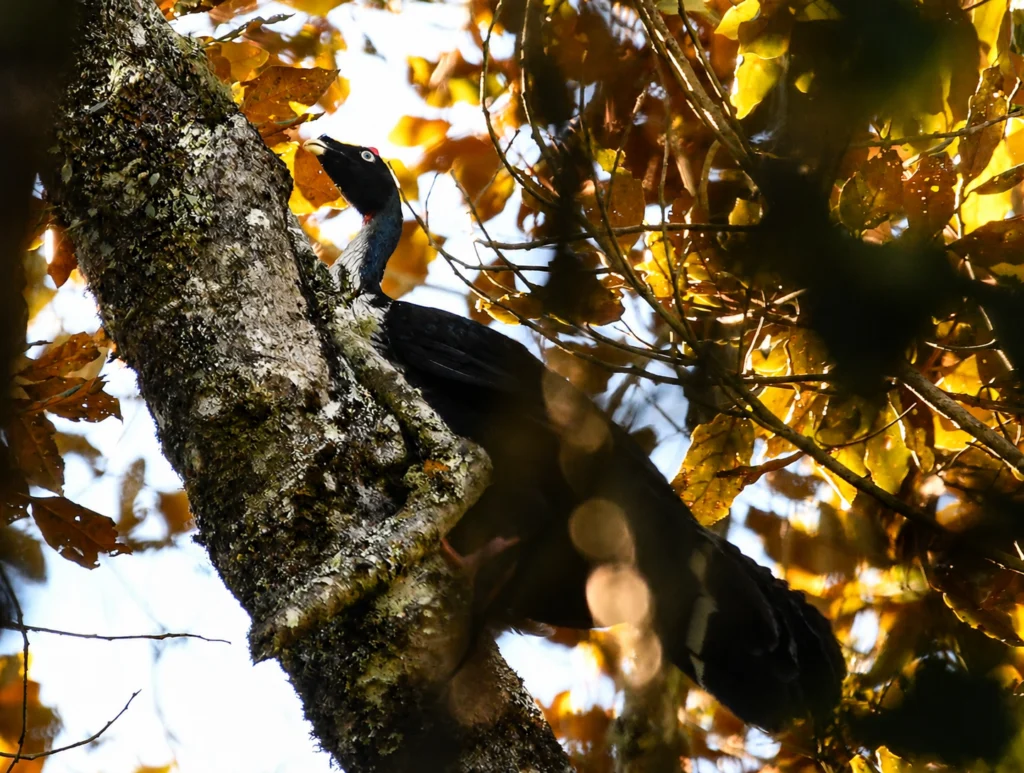
- The Horned Guan (Oreophasis derbianus), a heavy black-plumaged bird with a striking red horn on its head. It lives in the cloud forests of Chiapas and Guatemala, and its population is so small that the IUCN lists it as Endangered.
- The Brown-backed Solitaire (Myadestes occidentalis), recognisable by its metallic, flute-like song, lives in the mountain pine-oak forests.
- The Bushy-crested Jay (Cyanocorax melanocyaneus), a dark blue, noisy corvid that moves in loud flocks through the mountain understorey, from Guatemala to Nicaragua.
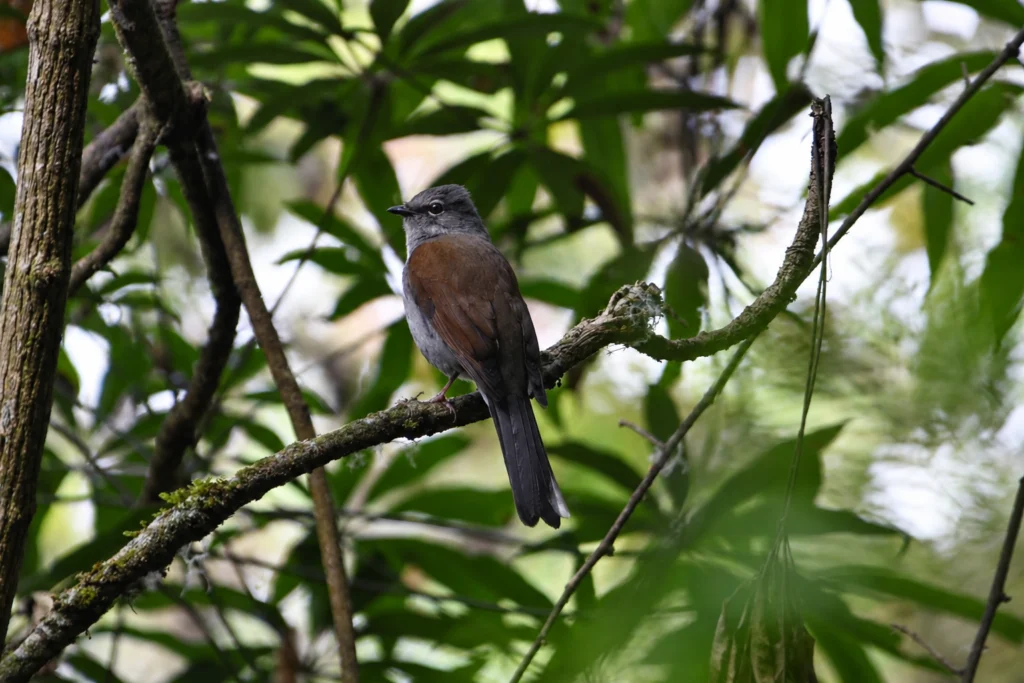
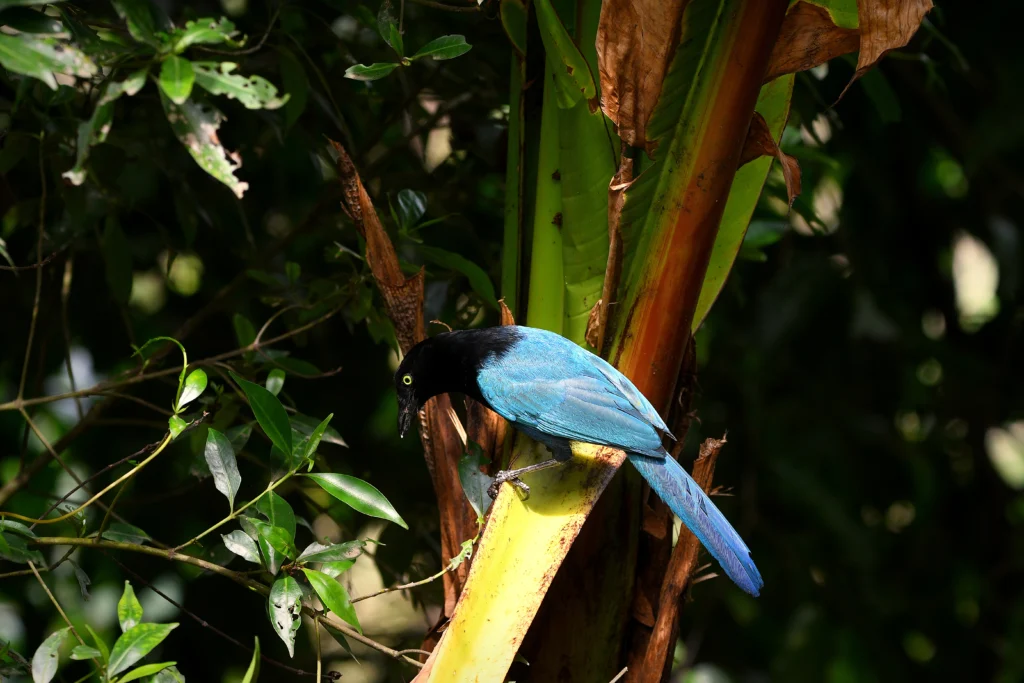
These are only three examples among more than 200 Mesoamerican endemic species, one of the continent’s ornithological treasures.
Why should these birds matter to us?
Regional endemics are part of the natural heritage Guatemala shares with its neighbours, and that is what connects us as a Mesoamerican region. They also represent a concrete economic opportunity: every year, birders from around the world travel up to our mountains to see species like the Horned Guan or the Pink-headed Warbler, which supports nature tourism in rural communities.
They also work as indicators. Because their survival depends on very specific habitats — high-altitude cloud forest, for instance — their presence or absence tells us a great deal about the health of those ecosystems. Protecting these birds means protecting the forests and the resources people depend on too.
Have you seen one yet?
Next time you walk through a mountain forest in Guatemala, pay attention: you could be standing in front of a species that exists nowhere else in the world.
References
- Eisermann, K., & Schulz, U. (2005). Birds of a high-altitude cloud forest in Alta Verapaz, Guatemala. Revista de Biología Tropical, 53(3–4), 577–594. https://doi.org/10.15517/RBT.V53I3-4.14672
- Morrone, J.J. (2014) Biogeographical regionalisation of the Neotropical region. Zootaxa, 3782 (1), 1–110. https://doi.org/10.11646/zootaxa.3782.1.1
- Morrone, J.J. (2023). Endemism. In S. M. Scheiner (Ed.), Encyclopedia of Biodiversity (3rd ed.). Academic Press. https://doi.org/10.1016/B978-0-12-822562-2.00151-1